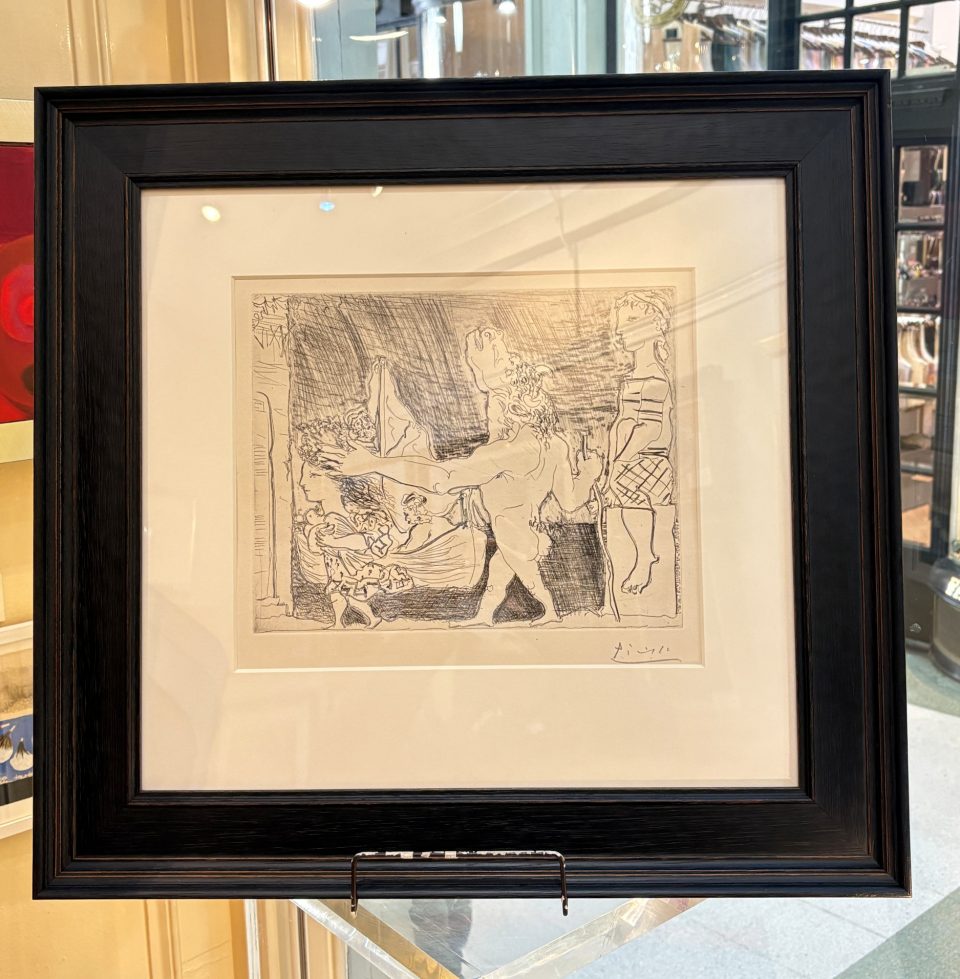
Minotaure aveugle guidé dans la nuit par une petite fille au pigeon
View all works in the seriesEtching, 1934/39, on verge de Montval laid paper, with watermarked Picasso, plate 96 from the Vollard suite, from an edition of 260 copies, signed in pencil lower right. Printed by Lacourière, and published by Ambroise Vollard, Paris. Dimensions: image: 23.5 x 29.4 cm; sheet 34 x 44 cm. Reference: Bloch 223; Baer 435.
In the Vollard Suite, the monumental set of etchings that Picasso created for Ambroise Vollard over 9 years, from 1931 to 1939, there are only four variations on the theme of the Blind Minotaur, all executed around 1935. The first three are a progression towards the final state, one of the artist’s most famous and valuable works, immediately recognisable by its deep black, starry night sky. The present etching is the third variant.
Although the elements of the composition are constantly rearranged and reimagined, they remain fundamentally the same throughout the four etchings: a blind Minotaur, screaming in pain and anguish, is led by the hand by a serene little girl; beside them appears Jason’s ship the Argo, in the act of hoisting its black sail (a mistake which would cost Jason’s father his life). Completing the composition is the enigmatic figure of Marie-Thérèse Walter, standing to one side, and leaning against a prop, in a half-resting position.
The origin of the image of the blind mythical creature led by a child is documented in John Richardson’s Vol. I of A Life of Picasso: in the Paris of the first years of the century, when Picasso, Modigliani and their contemporaries were still bohemian, penniless artists in Montmartre, selling some of their cheaper drawings at small dealers and in their poor studios, one figure wandering these places caught the young artist’s attention: an elderly man, by the name of Pere Angely, completely blind, led by the hand by a very young girl, would do the rounds of the small ateliers and dealers of Montmartre and ask the child to describe him this or that drawing on display, which he would then proceed to buy on the basis of her descriptions.
In a typical alchemical bravura performance, the artist miscegenates this episode from his past with figures of the present (Marie-Thérèse) and innate fears and sense of guilt, in an effort to exorcise all manner of demons agitating in his mind, not least, the spectre of another approaching world war: the desperate scream of the blind Minotaur to the sky is the precursor of the dying horse in Guernica. In addition, in our variant, the fillette is carrying in her hand a dove, thus providing a gentle contrast with the anguished scream of the Minotaur.. This is, again, a clear transitional symbol: derived entirely from one of the subjects of Picasso’s father, the pigeon painter Jose’ Ruiz , this is now the precursor of the controversial Dove of Peace of the Stalinist ’50s.
The richness and complexity of the method of this composition have occupied generations of critics and scholars, with debate and study by no means extinguished (yet), but with the universal consensus that the Blind Minotaur series is of paramount importance in the artist’s graphic oeuvre.