

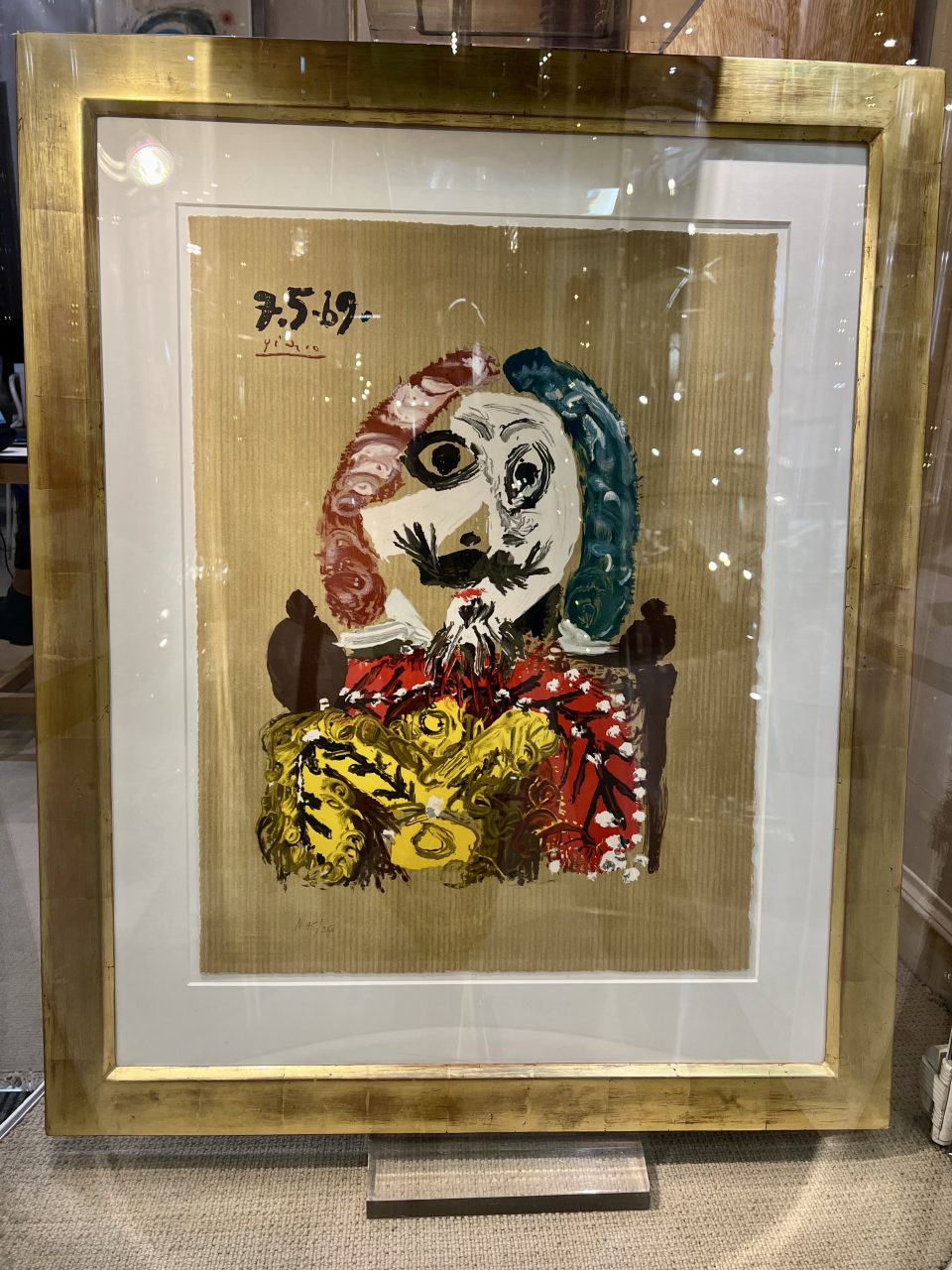
Portrait Imaginaire 7.5.69
View additional images[After] Colour lithograph, 1969, by Marcel Salinas under Picasso’s commission. Numbered A95 of 250 copies of the American edition (there were also 250 copies of the French edition). Dimensions: 65.5 x 50 cm. Published by Harry N. Abrahams, New York, 1969. From the Portrait Imaginaires portfolio.
Notes on Portraits Imaginaires:
At the beginning of 1969 Picasso was in Mougins, on the French Riviera. It was a tiring time for the great artist. He was having a series of exhibitions in Avignon, and was being ferociously attacked in some of the press. He had been quite ill, and recuperation was taking its time. And, at 88, old age was finally knocking strongly at his door.
In Mougins he salvaged and recycled a set of cardboard sheets, from a consignment of art materials. The different textures and appearances of these sheets of carton appealed to him and he viewed the large panels of cardboard as canvases, so he set to work: from the 30th of January 1969 to the end of May, during one of his famous bursts of creative energy, he created a large number of portraits on different sheets of cardboard, all variants of XVIIth century musketeer-type of gentlemen (and one woman, in a mantilla). Each portrait was in gouache with simple and brilliant colours. They are all clearly linked together, each a transformation, or mutation, from the earlier one. As usual, Picasso did not title his works but the individual portraits can be identified with the date, appearing in the same style on them all, and, if more than one was produced in the same day, with a sequential number that he added in Roman numerals. The whole series became known as Portraits Imaginaires or Imaginary Portraits. The series was first exhibited at the Galerie du Dragon in Paris, belonging to his friend Zervos, and there a young publisher called Charles Feld saw them and conceived the idea of reproducing some of them in lithography. He submitted the idea to Picasso and, for the first time in his life, the artist consented to have his original work reproduced in lithography. An important part of the stipulation was that the different types of cardboard were to be reproduced exactly. The artist chosen for the task was Marcel Salinas, and Picasso supervised the process throughout, selecting the 29 portraits to be reproduced, authorizing the printing only when completely satisfied. The printing was done at the Ateliers Dethuit and Guilard-Gourdon; the process took over a year and, upon completion, the plates were destroyed. This was going to be the last of the great cycles of Picasso lithographs. Each print is hand numbered and carries, in the plate, the signature of Picasso as it appears on the original gouache portraits. Two editions exist; “A” for the American market, and “F” for the French, each of 250 copies.